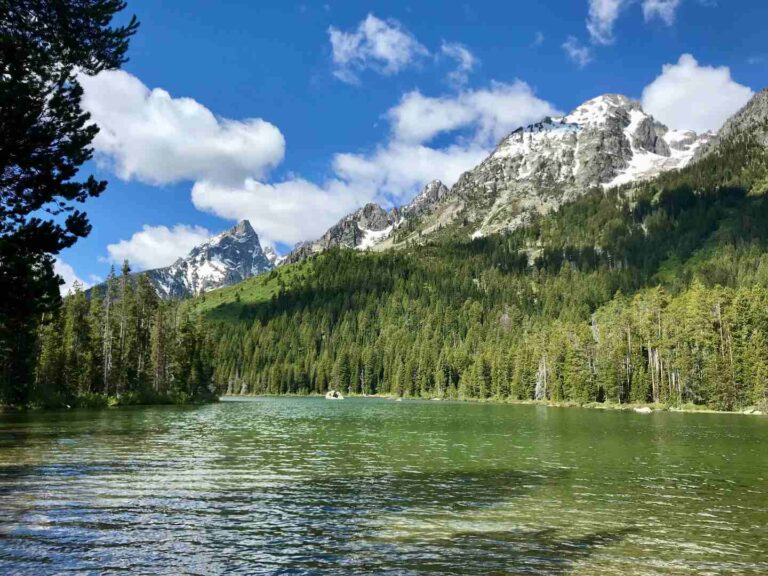

Grand Teton and Yellowstone Itinerary: The Perfect 10-Day Road Trip
Planning a Grand Teton and Yellowstone itinerary? These two iconic national parks sit just 60 miles apart in northwestern Wyoming, making them the perfect combination for one unforgettable 10-day road trip.
Spend 4 days hiking the dramatic peaks and crystal-clear lakes of Grand Teton National Park, then head north for 4 days in Yellowstone, where geysers erupt on schedule, rainbow-colored hot springs defy description, and bison bring traffic to a complete standstill on a regular basis.
We visited both parks in late June and came away with some of our most memorable experiences. Snow on the trails in June, a grizzly in the meadows, a winter wonderland at Lake Solitude, and crowds at Old Faithful that somehow still felt worth it. This trip delivers! Here’s exactly how to plan your Grand Teton and Yellowstone itinerary, day by day.
This post may contain affiliate links, which means I’ll receive a commission if you purchase through my links, at no extra cost to you. Please read our full disclosure for more information.
Best Time to Visit Grand Teton and Yellowstone
It’s best to visit Grand Teton and Yellowstone during the late summer months. We recommend visiting in late June, July, or August. During these warmer months, you can hit the trails, and everything should be mostly snow-free along the trails in the higher elevations.
That being said, it’s possible there could still be snow in the higher elevation areas of the parks. We traveled to these national parks in late June and were met with a winter wonderland on a few of our hikes in both parks! The parks had a record snowpack the prior winter, so it made for an interesting trip.
During the winter months, you may run into road closures and bitterly cold temperatures, so plan accordingly. Spring in the parks welcomes the awakening of animals and plants, but most things are still closed and snow-covered. Fall is a great time to visit as well, but you’d better get there before the first heavy snowfall arrives.
Grand Teton National Park is technically open year-round. However, from November through April, some roads, campgrounds, and most visitor centers are closed. Due to the snow in the winter, Yellowstone’s roads are usually all closed until mid-April. Visitor Centers and other facilities usually start opening during May in both parks.

Grand Teton and Yellowstone Itinerary at a Glance
Here is a quick table with an overview of what your Grand Teton and Yellowstone itinerary could look like. For our recommendations on exactly where to stay, keep reading.
| Day 1 – Fly into town. Pick up your rental car, go shopping, and rest. | Travel Day Rest in Jackson Hole, WY, or Victor, ID |
| Day 2 – Grand Teton National Park: Taggart Lake, & Jenny Lake | Rest in Jackson Hole, WY, or Victor, ID |
| Day 3 – Grand Teton National Park: Hike through Cascade Canyon to Lake Solitude | Rest in Jackson Hole, WY, or Victor, ID |
| Day 4 – Grand Teton National Park: String, Leigh, Bearpaw, and Trapper Lakes, Snake River Float Trip | Rest in Jackson Hole, WY, or Victor, ID |
| Day 5 – Grand Teton National Park: Amphitheater Lake or Signal Mountain, & Schwabacher Landing | Rest in Jackson Hole, WY, or Victor, ID |
| Day 6 – Mormon Row, Yellowstone National Park: Mormon Row, West Thumb Geyser Basin, Hayden Valley & Grand Canyon of the Yellowstone | Rest in Cooke City, MT |
| Day 7- Yellowstone National Park: Lamar Valley, Mount Washburn, & Mammoth Hot Springs | Rest in West Yellowstone, MT |
| Day 8 – Yellowstone National Park: Bunsen Peak & Norris Geyser Basin | Rest in West Yellowstone, MT |
| Day 9 – Yellowstone National Park: Fairy Falls, Grand Prismatic Spring, & Old Faithful | Rest in Jackson Hole, WY, or Idaho Falls, ID |
| Day 10 – Travel home | Travel Day |
| Closest Airports | Jackson Hole Airport and Idaho Falls Regional Airport |
Explore Grand Teton and Yellowstone with ease using our detailed map and day-by-day itinerary. Each numbered stop marks a day of your journey, while color-coded routes highlight top sights, must-see landmarks, and the best hikes and activities for each day. Planning your national park adventure has never been simpler!
How Much Does a Trip To Grand Teton & Yellowstone Cost?
You might be curious about how much a trip here will cost, right? So let’s break down what you might expect to spend. This estimate is based on our 2019 trip, so prices have likely gone up a bit because, honestly, what hasn’t? These figures cover most of the major expenses, though they don’t include food or gas.
| Category | Budget Range (2 people) | Notes |
| Flights | $1,500+ | Varies widely by departure city; book early on Booking.com or Expedia. |
| Rental Car | $560 | Book pay-later so you can reprice; see our rental car guide |
| Hotels/Accommodations | $1,800 | Our accommodations ranged from $144-321 a night. 9 nights total. |
| America The Beautiful Pass | $80 | Covers both parks. Get it here before you go! |
| Activities & Tours | $300 | Budget for a Snake River Scenic Float Trip |
| Estimated Total | $4,240 |
Airfare and rental car prices can fluctuate quite a bit depending on timing, demand, and availability, so it’s worth checking rates frequently and booking when you find a good deal. It may be cheaper to fly into nearby Idaho Falls instead of Jackson Hole. As always, eat breakfast and lunch on the road and only go out for dinner to save money.
Planning Your Grand Teton and Yellowstone Road Trip
Getting There
This road trip starts and ends in the Jackson Hole area, giving you two realistic airport options. Jackson Hole Airport (JAC) is the most convenient. It sits right inside Grand Teton National Park and puts you less than 30 minutes from your first trailhead.
The catch is that it’s one of the most expensive small airports in the country, with limited direct flights mostly from major West Coast and hub cities.
Idaho Falls Regional Airport is where we flew in, and we’d do it again. Fares were substantially cheaper, and the 2-hour scenic drive through eastern Idaho to Victor or Jackson is genuinely beautiful. Worth the trade-off. Check out your options on Booking.com now or visit Expedia.
Wildlife Viewing Tips
One of the things that makes a Grand Teton and Yellowstone itinerary unlike any other national park trip is the sheer abundance of wildlife. Knowing how to find it makes a real difference. Here are a few things we learned:
Timing is everything. Early morning and evening are when animals are most active. If you want to see wolves, grizzlies, or elk, your best chance is in the first two hours after sunrise or the last two before sunset. Midday is for hiking, so leave the wildlife spotting for the edges of the day.
Bring binoculars. This is non-negotiable. Most wildlife in both parks is spotted at a distance. You may spot wildlife across a meadow, on a distant ridge, or on the far bank of a river. A good pair of binoculars transforms a tiny brown speck into a grizzly bear.
Lamar Valley is the crown jewel. Often called the Serengeti of North America, the Lamar Valley in the northeastern corner of Yellowstone is the single best wildlife viewing area in the continental United States. Bison, elk, coyotes, grizzly bears, and wolves all call this valley home.
We saw grizzlies out in the meadows and lost count of the bison. Plan to spend extra time here and factor in the bison jams. Think of them as a traffic jam, except caused by 2,000-pound animals who answer to nobody. 😄
Schwabacher Landing in the Tetons is your moose hotspot. We didn’t see one during our visit, but Schwabacher Landing is one of the most reliable places in Grand Teton to spot moose in the willows along the river, especially early morning. Get there at sunrise if you can. Then head to Mormon Row.
Always keep your distance. Both parks require you to stay at least 100 yards from bears and wolves, and 25 yards from all other wildlife. This is for your safety and theirs. If an animal changes its behavior because of you, you’re too close. Don’t pet the fluffy cows!
Things to Know
- Plan to carry bear spray when hiking in the Grand Tetons and Yellowstone. Learn more about how to differentiate between a black bear and a grizzly bear and what to do if you encounter one.
- Please note that bear spray is not permitted on an aircraft in carry-on or checked bags, so you will need to buy or rent bear spray when you arrive.
- We ended up purchasing bear spray at a local outfitter in Jackson and then donated it to our hotel to give out when we left Yellowstone.
- Get to all trailheads early to guarantee parking. During the summer months, parking areas can fill up very quickly, especially in Yellowstone National Park. Also, be prepared for tour buses and LOTS of people. If you can get away from the popular areas and out on the trails, you will be met with significantly fewer people.
- An interagency pass is the best bang for your buck. The pass expires after one year, but it usually pays for itself if you visit enough parks in one year. Visit our gear page to purchase your America the Beautiful Pass online at REI’s website.
- When you are out hiking and enjoying our open spaces, be sure to practice Leave No Trace.
- Even in late June, significant snowpack can close trails and alter your plans. We experienced this at both parks. Always check current conditions at nps.gov and have backup trails in mind for each day.
Rental Car
- We usually book our rental car super early as a pay later option. If you do this, you can continuously check the prices before your trip. If the price is lower than when you booked, cancel for free and rebook for the lower price! Most major rental car companies have free cancellation on pay later bookings, but always check the fine print.
- Make sure to take a video of the outside AND inside of the car before you leave the rental car lot. This will save you from any damage claims made by the rental car company after your return. We know from a very bad experience on this! Check out our post for more information on rental cars.
🚗 Book now!! Check prices and options for rental cars on Expedia or at Booking.com.
Where to Stay While Visiting Grand Teton National Park
Jackson Hole is the perfect spot to stay while spending 4 days in Grand Teton National Park. It’s also possible to stay a bit farther away in Victor, Idaho. Here are some of the top accommodations:
- Flat Creek Inn: This roadside motel is located directly across from the National Elk Refuge. Clean and comfortable. This is one of the closest hotels to Grand Teton National Park, situated just north of Jackson Hole. We had a great stay here during part of our trip! Book it here at Expedia or Booking.com.
- Wyoming Inn of Jackson Hole: Just minutes from downtown. Rooms feature private fireplaces and views of Wyoming’s surrounding wild beauty. Pet-friendly, hot tub, and a restaurant is located on site. Check it out on Expedia or Booking.com.
- The Rockwell Inn: Luxury accommodations in Jackson Hole. Begin each day with a hearty breakfast. Free parking, an on-site pool and hot tub, and fresh-baked cookies in the afternoon. Reserve your room on Expedia or Booking.com.
- Cobblestone Hotel & Suites – Victor, ID: A newer hotel offering free breakfast. However, this hotel is about 1.5 hours from Grand Teton National Park. That being said, it’s possible it could be cheaper than others in Jackson Hole during the high season. We stayed here due to this exact reason. We loved it! Book your stay on Expedia or Booking.com.
Where to Stay While Visiting Yellowstone National Park
We recommend staying outside the park while exploring Yellowstone National Park, unless you are camping, of course. Check out some of the options that we recommend based on location below:
- Gardiner (North) – Yellowstone Village Inn: Clean, comfortable, and super convenient to the northern section of Yellowstone. Free coffee anytime and a chance to see wildlife on the huge front lawn. Indoor pool open seasonally with multiple room types available. Book a stay on Expedia or Booking.com.
- Cooke City/Silver Gate, MT (East) – High Country Motel & Cabins: We stayed here in a cabin for one night so we would be super close to Lamar Valley in the morning for the best chance of spotting Yellowstone’s wildlife. Super rustic and limited cell service. However, it is located in town and close to restaurants. We loved it! Check it out here on Booking.com.
- West Yellowstone, MT (West) – Alpine Motel: #1 in West Yellowstone and one of our favorite stays with super-friendly owners and competitive rates. Free parking and air conditioning. It might be a little dated, but it’s immaculately clean! Visit their website and give Brian and Patty a call!
Day 1 – Travel Day To The Grand Tetons
It’s time to head to the mountains! On our Grand Teton and Yellowstone itinerary, we flew into Idaho Falls as it was substantially cheaper than Jackson Hole. Depending on your plans, both are within good proximity for a flight in, but note that Jackson Hole is about 2 hours from Idaho Falls.
When you decide on an airport, it’s time to book your rental car! Whichever you choose, make sure to take a video of the outside AND inside of the car before you leave the rental car lot. This will save you from any damage claims made by the rental car company after your return. We know from a very bad experience on this!
From the Idaho Falls Airport, drive to and spend the night in Victor, ID. This worked out really well for us in the end due to our travel issues. We almost got stranded in Denver during intense thunderstorms on our travels. We got on the last flight to tiny Idaho Falls and arrived at 3 am, only 8 hours after our planned time!
Alternatively, you can establish your home base for your 4 days in Grand Teton National Park in Jackson Hole, WY. We found that it was a substantial cost increase, and we didn’t mind the extra drive time to save money and rest in Victor, ID.
Day 2 – Taggart Lake & Jenny Lake

It’s time to hit the trails on your first full day at Grand Teton National Park. This national park is one of our absolute favorites, hands down. If you haven’t been, the drive from Jackson Hole to the Grand Tetons is something out of a movie. When the mountains come into view as you head north, it’s a sight to behold!
First up, we recommend a nice, short, easier hike to get yourself started. Hit the Taggart Lake Trail for a nice 4-miler first, and then head to Jenny Lake. If you want to hike more near Taggart Lake, Bradley Lake is just a short connector trail away.
Jenny Lake is one of the more popular areas of the park, complete with one of the visitor centers, and you have the option to hike around the entire lake or just go for a short stroll. You can also rent kayaks and canoes or take a scenic cruise on Jenny Lake, depending on the season and water temperature.
🛥️ Get the full details on Taggart Lake and Jenny Lake on our additional posts!
Day 3 – Cascade Canyon: Hidden Falls, Inspiration Point, & Lake Solitude

Next up is an epic backcountry hike in the Tetons. Head back to Jenny Lake to start the hike to Cascade Canyon, Hidden Falls, Inspiration Point, and Lake Solitude.
The trail to all of these amazing destinations starts at the back of the lake. Take the Jenny Lake Shuttle or hike around to get there. Once you arrive, take the trail to Hidden Falls and Inspiration Point. These two spots are close to the Jenny Lake Shuttle and are perfect if you are looking for a short hike.
Keep hiking past Inspiration Point through Cascade Canyon and make your way to Lake Solitude. The entire hike to Lake Solitude and back is about 14 miles, and it just might turn into a winter wonderland as you make your way toward the lake! We had to end our hike early and turn back because the snow got so deep. Better to be safe than sorry!
⛰️ Get all the details and learn more about our hike through Cascade Canyon to Lake Solitude here!
Day 4 – String Lake, Leigh Lake, Bearpaw Lake, Snake River Float Trip

Next, spend a day of relaxation with another nice hike and a float down the Snake River. Wait…relaxation? Sure! The 10-mile hike along Leigh Lake to Bearpaw and Trapper Lakes is very leisurely with little to no elevation gain. Do as much or as little as you want.
🚣🏽♀️ Get all the details on these easy hikes in Grand Teton National Park.
Leigh Lake is absolutely beautiful! That being said, the mosquitoes will be plentiful, so it’s best to take your bug spray and head net just in case! This was one of our favorite spots.
In the afternoon, it’s time for some real relaxation. Take a Snake River float trip! This is a perfect trip for those who aren’t looking for the thrill of whitewater. Children and older adults will love this as well. Float down the Snake River as you look for wildlife and enjoy the stunning scenery of the Grand Tetons.
🚣🏽♀️ For more options, including whitewater trips, check out more tours from Viator!
Day 5 – Signal Mountain or Amphitheater Lake, &
Schwabacher Landing

Today, head out on another hike to explore more of Grand Teton National Park. We recommend completing Amphitheater Lake if the weather permits. This is a strenuous 10-mile hike up to Surprise Lake and Amphitheater Lake. Unfortunately for us, due to the heavy snowpack from the prior winter, the park rangers advised us not to complete this hike.
Instead, we headed to Signal Mountain on their recommendation. Start this hike at the Signal Mountain Lodge near Jackson Lake. A somewhat easy/moderate hike rewards you with epic views of the Teton Range at Jackson Point. You can also drive to the Signal Mountain summit – the highest point in the park accessible by car!
⛰️ Get all the details on the Signal Mountain Trail right here.
Finally, you can’t miss a visit to Schwabacher Landing, so add this to your itinerary. Schwabacher Landing offers stunning views of the Grand Tetons with amazing scenery. I’m sure you have all seen photos taken here. Sadly, we didn’t see a moose, but it’s still a destination you can’t miss.
Day 6 – Mormon Row, West Thumb Geyser Basin, Hayden Valley & Grand Canyon of Yellowstone

Continue your Grand Teton and Yellowstone itinerary and head north to Yellowstone National Park. But wait! Before you head north, stop at Mormon Row. Now, we know you have seen these barns in plenty of photos. The sunlight is perfect in the morning, so be sure to get there early to beat the crowds as well.
🌄 Details on Mormon Row are right here. Check it out!
After enjoying some time at Mormon Row, head north and enjoy the scenery at Oxbow Bend, another popular spot for photography. Then, it’s time to spend 4 days in Yellowstone via the John D. Rockefeller, Jr., Memorial Parkway.
Start your day at the West Thumb Geyser Basin, where there are tons of cool geothermal pools and features. Then, drive through Hayden Valley and be on the lookout for wildlife. Finally, head to the Grand Canyon of the Yellowstone, where a hike on the Clear Lake Trail and the South Rim Trail will lead you to Artist Point and views of Upper and Lower Falls.
🌲Here is the full guide on visiting the Grand Canyon of the Yellowstone using Clear Lake and Artist Point trails.
Finally, drive through the Lamar Valley and spend the night in Cooke City.
Day 7 – Lamar Valley, Mount Washburn, & Mammoth Hot Springs

Maybe you are asking, why stay all the way out in the middle of nowhere in Cooke City? Well, today, get out early and drive through nearby Lamar Valley and try to spot wildlife. Lamar Valley is one of the best places in Yellowstone to spot bison, elk, coyotes, grizzly bears, and wolves. We hope you don’t get stuck in a bison jam! We saw tons of bison here and a grizzly or two out in the meadows.
Next, head to Mount Washburn for a nice hike to the summit. Parking can be very limited at the Dunraven Pass parking area, so get there as early as you can. Mount Washburn sits at 10,243 feet, so this hike is strenuous. Note that a high snowpack can cover the trail through June and into July, so be prepared to turn around as needed.
➡️ Read the full details here on our day hiking Mount Washburn and Mammoth Hot Springs.
During our hike, we had to do just that. Instead, we drove north to the Chittenden Service Road and used that route instead. The view from the summit of Mount Washburn is worth the effort! As we reached the summit, the plowed snow was taller than both of us!
Finally, drive north to Mammoth Hot Spring and hike the terraces. You have the option to head to West Yellowstone to spend the night, which is a bit of a drive (1.5 hours), or you can stay in nearby Gardiner, just 15 minutes north.
Day 8 – Bunsen Peak & Norris Geyser Basin

Spend some more time on the trails with a hike on the Bunsen Peak Trail. A shorter mile hike will lead you to this summit, where excellent views await. This area is sometimes known for grizzly bear activity, so be bear aware. That being said, we didn’t see any during our hike.
🌲 Check out these posts for more details on Bunsen Peak and the Norris Geyser Basin.
Finally, when spending 4 days in Yellowstone, you can’t miss the Norris Geyser Basin. This is one of the most fun and colorful areas of the park. During our visit here, the weather produced some lenticular clouds, which made it look so much more otherworldly and interesting.
Day 9 – Fairy Falls, Grand Prismatic Spring, & Old Faithful

Your last day in Yellowstone is full of hiking and, of course, a visit to watch Old Faithful. Spend the morning checking out the Grand Prismatic Spring and then hit the trails to hike to Fairy Falls. The trail leading to Fairy Falls has an epic overlook of the Grand Prismatic Spring that you don’t want to miss.
Last up is a visit to watch an Old Faithful eruption. Drive to the Old Faithful Visitor and Education Center to find a time when Old Faithful is predicted to erupt. This is a very popular activity, so you’ll want to be in place early to get a good spot to watch.
After that, be sure to check out the Old Faithful Inn, a national historic landmark built in the early 1900s. The towering lobby with a fireplace and exposed timbers is definitely an interesting point when visiting. If you want to stay here, the Inn is open from early May through early October.
🏞️ Get the details on hiking to the Grand Pristmatic Spring and Fairy Falls right here.
Day 10 – Travel Day
Day 10 of your Grand Teton and Yellowstone itinerary is a travel day. Depending on when your flight leaves and where it leaves from, it’s a free day for exploring either of the parks and some areas that you might have missed. As always, we like to build in these travel days to our itineraries so you know what to expect.
🧭 If this itinerary was helpful in planning, check out our other itineraries on more national parks right here!
Frequently Asked Questions
How many days do you need for Grand Teton and Yellowstone?
Ten days is the sweet spot. 4 days in Grand Teton, 4 days in Yellowstone, and 2 travel days. This gives each park the time it deserves without feeling rushed. If you only have 7 days, we’d prioritize Lake Solitude and Jenny Lake in the Tetons, and Lamar Valley, Grand Prismatic Spring, Old Faithful, and Mount Washburn in Yellowstone. That combination captures the very best of both parks.
Should you visit Grand Teton before or after Yellowstone?
Grand Teton first, then Yellowstone, and that’s exactly how this itinerary is structured. Starting in Grand Teton lets you fly into Jackson Hole or Idaho Falls, settle in, and build your hiking legs before tackling Yellowstone’s more spread-out landscape. The natural geographic flow also works in your favor. You drive north from the Tetons into Yellowstone via the John D. Rockefeller, Jr. Memorial Parkway, which is a spectacular scenic transition.
What is the best base for visiting Grand Teton National Park?
Jackson Hole is the most convenient base. It puts you within 30-45 minutes of all the major trailheads. That said, Jackson Hole is one of the pricier small towns in the West. We stayed partly in Victor, Idaho (about 1.5 hours from the park) and partly at the Flat Creek Inn just north of Jackson, and both worked well. If budget is a factor, Victor is worth the extra drive time.
Do you need bear spray at Grand Teton and Yellowstone?
Yes, absolutely. Both parks have active grizzly bear populations, and bear spray is strongly recommended on all trails. You cannot bring bear spray on a plane, so plan to buy or rent it when you arrive. We picked ours up at a local outfitter in Jackson for about $50 and donated it to our hotel when we left Yellowstone. Many hotels pass bear spray on to incoming guests, so it’s worth asking at check-in.
What is the best time of year for a Grand Teton and Yellowstone itinerary?
Late June through August is the sweet spot for hiking and wildlife viewing. That said, even late June can bring significant snowpack. We encountered waist-deep snow at Lake Solitude and snow taller than us at the Mount Washburn summit, all in the third week of June. Always check current trail conditions before you go and have backup plans ready. Fall is also spectacular for fewer crowds and elk rut activity, but some facilities close, and early snowfall is possible.
Is a Grand Teton and Yellowstone Itinerary Worth 10 Days?
This epic Grand Teton and Yellowstone itinerary is complete! We had an awesome time exploring both the Grand Tetons and Yellowstone. Since these parks are so close to one another, you should definitely plan on visiting both when in the area.
Our favorite hike in Grand Teton National Park was Lake Solitude. It was so much fun going from warm weather down by the lake to a winter wonderland as we hiked. We even had to turn around because the snow got waist-deep and we couldn’t find the trail! The Grand Tetons are one of the most picturesque mountain ranges we have seen.
Our time in Yellowstone was also amazing! The abundance of wildlife as you drive around this scenic park is unforgettable. Just make sure you plan some extra time if you encounter a bison jam. Think of it as a traffic jam, but caused by bison on the road. We also really enjoyed hiking to Mount Washburn, where the snow was taller than us!
We know your Grand Teton and Yellowstone itinerary may look different than ours, but we hope this helps you in planning an unforgettable trip of your own.
Don’t forget to pin this post for future planning! Just click the save button located on any image.